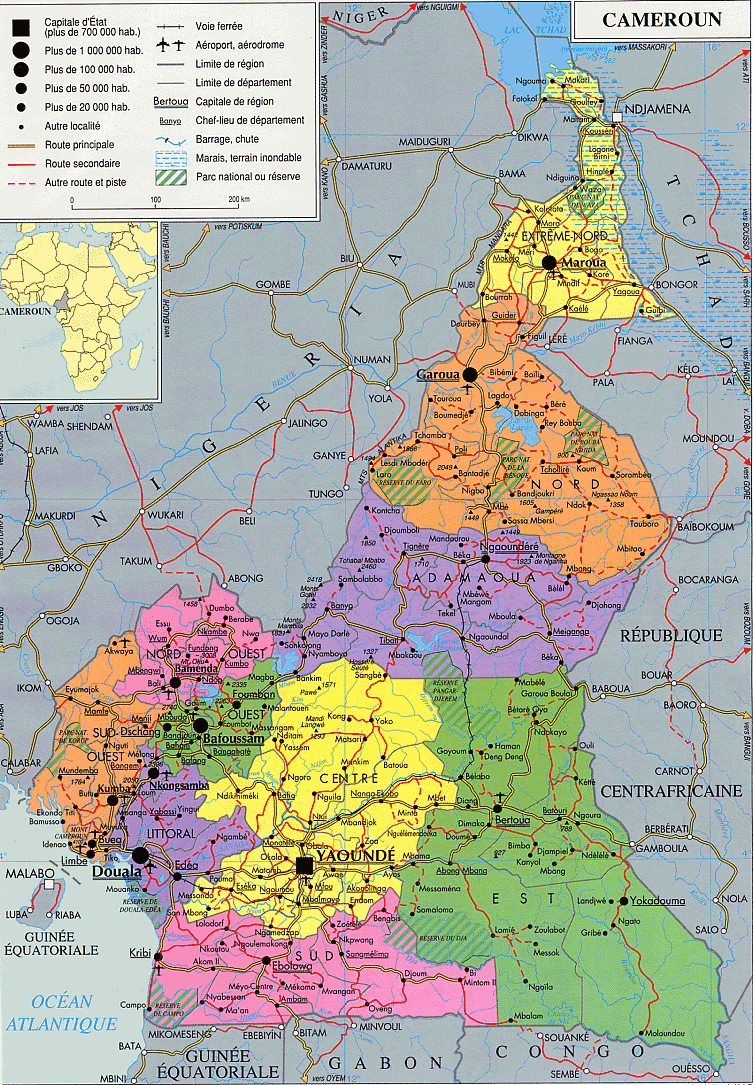
FACTS AND STATISTICS Location: Western Africa, bordering the Bight of Biafra, between Equatorial Guinea and Nigeria |
THE PEOPLE Cameroon has a diverse population comprising approximately 250 ethnic groups that then form 5 regional/cultural groups. These are western highlanders (also called grassfielders), which include the Bamileke, Bamoun, and many smaller groups in the northwest; coastal tropical forest people, which include the Bassa, Doula, and many smaller groups in the southwest; southern tropical forest people, which include the Beti, Beulu, Fang, and Pygmies; Muslims of the northern semi-arid regions and central highlands, which include the Fulani; and the Kirdi, non-Muslims peoples of the northern desert and central highlands
|
LANGUAGE IN CAMEROON Cameroon is home to 230 languages. These include 55 Afro-Asiatic languages, two Nilo-Saharan languages, and 173 Niger-Congo languages. This latter group is divided into one West Atlantic language (Fulfulde), 32 Adamawa-Ubangui languages, and 142 Benue-Congo languages (130 of which are Bantu languages). English and French are official languages, a heritage of Cameroon's colonial past as both a colony of the United Kingdom and France from 1916 to 1960. The nation strives toward bilingualism, but in reality, very few Cameroonians speak both French and English, and many speak neither. The government has established several bilingual schools in an effort to teach both languages more evenly. Cameroon is a member of both the Commonwealth of Nations and La Francophonie. Kamtok, or Pidgin English, has in many ways been the lingua franca of Cameroon since the 1880s. It is commonly used as a vehicle for enhancing communication in this bilingual country that has approximately 250 native dialects. There are several variations on Kamtok based upon where it is used -- in grass fields, in the Catholic Church, in the Francophone areas of the country, in the southwest of the country, and among the Bororo cattle traders. |
||